
Hybrid publishing blends elements of traditional and self-publishing—authors invest in production (fully or in part) while working with a publishing partner that provides professional services like editing, design, distribution, and marketing support.
A useful way to think of the hybrid model (sometimes called partner publishing) is: you’re paying for a professionally managed
publishing process, but you typically keep more control and often earn higher royalties than in a traditional deal.
Hybrid publishing blends traditional and self-publishing, letting authors invest while keeping creative control and earning higher royalties.
For a quick overview of how hybrid fits among all major models, see Types of Publishing Paths.
Why hybrid publishing has become more common
Publishing has expanded far beyond a “traditional vs self-publish” binary. Authors today want more flexibility—often faster timelines than traditional publishing, more guidance than DIY self-publishing, and a clearer partnership structure. Hybrid publishing resembles self-publishing in that the author takes on cost/financial risk, while resembling traditional publishing in that professionals execute the production work.
If you’re comparing real-world expectations across models (including cost and timelines), The Publishers Guide and The True Cost of “No Cost” Publishing are helpful context.
How hybrid publishing bridges traditional and self-publishing
Quick definitions
Traditional publishing: a publisher funds production; the author typically trades some control and higher royalties for access, distribution, and publisher-led infrastructure.
Self-publishing: the author funds and manages the process (often hiring freelancers), usually keeping the most control and platform-based royalties.
Hybrid publishing: the author invests (fully/partly) while a publishing partner provides professional execution and infrastructure; terms vary widely, so vetting matters.
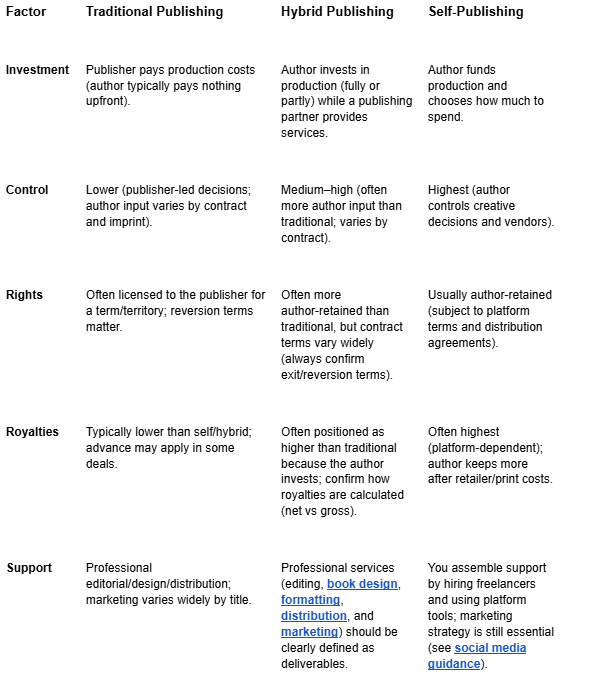
Traditional vs. Hybrid vs. Self-Publishing (at-a-glance)
Key features of hybrid publishing
1) Shared investment (and usually no advance)
Many hybrid arrangements involve the author covering production costs (or sharing them) and typically not receiving an advance—one of the clearest differences from traditional publishing.
2) Professional production services
A legitimate hybrid publisher should clearly define what it provides—editing, design, formatting, distribution setup, and marketing support—with scope, timelines, and deliverables.
For an example of how a hybrid publisher outlines support and services, visit Page Publishing Services. If you’re polishing your manuscript before any publishing path, Self-editing Your Book: A Guide for Authors can help you tighten the draft before professional editing.
3) More author control (but details vary)
Hybrid deals often offer more author input than traditional publishing, but “hybrid” covers a wide range of business models—so approval rights, revision limits, and decision-making power can vary.
4) Royalties and rights structure
Hybrid publishers commonly position themselves as higher-royalty options than traditional because the author is investing upfront. That said, royalty definitions can differ (net vs gross, cost recoupment, distribution deductions), so it’s important to confirm exactly how royalties are calculated.
How to tell legitimate hybrid publishing from vanity-style pitfalls
Because the term “hybrid” is used broadly, vetting is essential. In general, reputable hybrids emphasize transparency and quality standards—clear pricing, clear deliverables, professional editorial/design expectations, and contracts that are straightforward and fair.
Before signing, it can help to scan Writers Beware: 8 Publisher Red Flags and then run the deeper checklist: 11 Essential Questions to Ask Before Choosing a Vanity Publishing Service.
Pros and cons of hybrid publishing
Pros
- Professional help without fully surrendering control
- Often faster, more predictable timelines than traditional publishing
- Potentially higher royalties than traditional (structure varies)
Cons
- Upfront investment can be significant
- “Hybrid” quality varies widely—some offers are essentially expensive packages
- Marketing support may still require substantial author participation and should be explicitly defined
For a practical start on promotion planning, these author guides can help: Book Marketing Ideas for Authors, Promoting Your Book on a Shoestring Budget, and Maximizing Local Media Coverage. For distribution and print expectations, see Exploring Print on Demand (POD) for Authors.
