
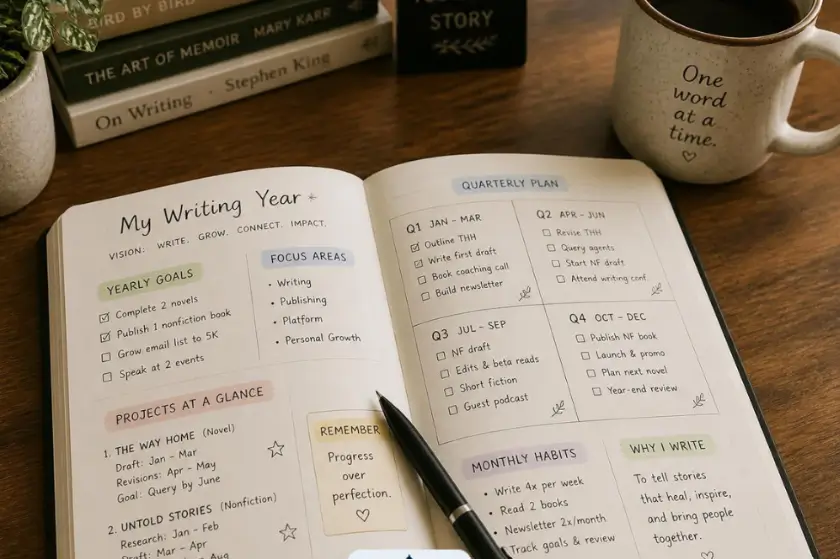
Most writers start the year with good intentions and a general sense of what they want to accomplish. By March, the specifics have blurred. By June, the momentum has slipped. By December, the year feels like it passed without the writing it was supposed to hold.
The difference between a productive writing year and a frustrating one is rarely talent or discipline. It is planning. Not rigid scheduling that leaves no room to breathe, but a clear enough roadmap that when life interrupts, which it will, you know where to return and how to get back on track.
This guide walks through how to build that roadmap for your writing year, from setting goals that hold up to structuring your time around them.
How Do You Plan a Writing Year?
Planning a writing year starts with identifying your one or two most important writing goals, then working backward from those goals to build a realistic monthly and weekly schedule. The plan should account for your actual available time, not an idealized version of it, and include natural checkpoints where you assess progress and adjust. Writers who plan in quarters rather than trying to map the entire year at once tend to stay more consistently on track, because the shorter horizon is easier to visualize, schedule around, and adapt when circumstances change.
Why Writers Need a Project Plan
Writing without a plan is not the same as writing freely. It often means spending creative energy on decisions that planning would have already resolved: what to work on today, whether to keep going or start something new, how close you are to finishing. Every hour spent on those questions is an hour not spent writing.
A project plan does not constrain creativity. It contains it in the best sense: it gives your creative work a structure to live inside so you can focus on the work itself. The most productive writers tend to be planners, not because planning is inherently productive, but because planning removes the friction that makes writing feel harder than it needs to be.
A writing plan also makes it easier to protect your time. When you know that Tuesday mornings are your draft hours, that protection has a reason behind it. Without the plan, writing time is always competing with everything else and losing.
Step 1: Set Your Writing Goals for the Year
Before you can plan the year, you need to know what you are planning toward. Writing goals come in different forms, and choosing the right type makes them far easier to track and achieve.
Output Goals
Output goals define what you want to produce: a completed first draft, a revised manuscript ready for beta readers, a published book, a collection of short stories, a certain number of blog posts. These are the clearest goals to plan around because they have a defined endpoint. You either finished the draft or you did not.
Process Goals
Process goals define how you want to write: a daily word count, a weekly writing session minimum, a habit of writing before email. Process goals are more within your control than output goals because they do not depend on external factors like publishing timelines or feedback cycles. They work well alongside output goals as the daily mechanism that gets you to the larger destination.
Learning Goals
Learning goals define what you want to understand better by the end of the year: a genre you have not written in, a craft element you want to develop, a workshop or resource you want to work through. These are worth including even for experienced writers because the craft of writing continues to develop throughout a career.
For most writers, the most useful annual plan combines one or two output goals with a process goal that supports them. Adding a learning goal alongside those gives the year depth beyond the manuscript. For guidance on setting specific targets at the project level before the annual plan, see our guide on how to outline a novel: a step-by-step guide for first-time authors.
Step 2: Audit Your Actual Available Time
The most common planning mistake writers make is building a schedule around ideal conditions rather than real ones. Ideal conditions rarely show up for more than a few weeks before life reasserts itself.
Before you build any schedule, spend one week tracking where your time actually goes. Note your work hours, your family and household commitments, your social obligations, and where your energy is highest and lowest during the day. The goal is not to judge how you spend your time. It is to understand it accurately so your writing schedule fits your life rather than fighting it.
Once you have that picture, identify the windows that realistically belong to writing. Even three focused hours per week, protected consistently, will move a manuscript forward faster than an ambitious schedule that collapses after two weeks. Consistent and modest outperforms ambitious and unsustainable every time.
| Available Time Per Week | Realistic Annual Output | What This Looks Like |
|---|---|---|
| 3-5 hours | One solid first draft (60,000-80,000 words) | One focused session per weekday morning or two longer weekend sessions |
| 6-10 hours | Draft plus revision, or two shorter projects | Two to three sessions per week with room for revision rounds |
| 10-15 hours | Draft, revision, and a second project or submission cycle | Daily writing with dedicated revision days |
Step 3: Break Your Goals Into Quarters
A year is too long to hold in your head at once. Breaking it into four quarters makes the plan visible and manageable, and gives you natural points to assess your progress and adjust course without abandoning the larger plan.
Quarter 1: Foundation
This is where you establish habits, clear whatever remained unfinished from the previous year, and begin working toward your primary output goal. For most writers, Quarter 1 involves either starting a new draft or returning to a project in progress with fresh intention. Treat this quarter as the one that sets the pace for the rest of the year.
Quarter 2: Momentum
By now your habits are either holding or showing cracks. Quarter 2 is where you address what is not working before it costs you the year. If your word count goals are not realistic, adjust them. If your schedule is not holding, look at what is competing for your time and make decisions. The writers who have a productive second half of the year are usually the ones who made honest adjustments in the second quarter rather than waiting until the end of the year to reflect.
Quarter 3: Push
If you are working toward a completed draft or a major revision, Quarter 3 is often where that work intensifies. This is also the quarter where writers hit resistance most often: the difficulty of a middle section, the energy required to sustain a long project, the temptation of new ideas. Having a plan that commits you to the current project through a defined endpoint makes it easier to stay rather than start over.
Quarter 4: Complete and Reflect
Quarter 4 carries two jobs: finishing the year’s work and evaluating what worked and what did not. Both matter equally. The evaluation at the end of the year is what informs the plan at the start of the next one. Write down what you accomplished, what you intended but did not reach, what habits held and which ones did not, and what you want to do differently. That reflection is the raw material for a better plan next year.
Step 4: Build a Monthly and Weekly Structure
Once you have quarterly goals, break each quarter into monthly targets and each month into weekly sessions. This is where the plan becomes something you can actually work from rather than a set of aspirations.
Monthly targets should be specific and verifiable. Not “work on chapter three” but “complete chapters three and four, roughly 5,000 words.” Not “revise” but “complete the revision of Part One, with all beta reader notes addressed.” The specificity is what makes it possible to assess whether you hit the target or not.
Weekly sessions should be scheduled at a fixed time wherever possible. The brain responds to routine. Writing at the same time, in the same space, on the same days reduces the decision-making friction that makes starting feel harder than it is. Over time, the routine itself becomes a cue that writing is what happens now.
Step 5: Track Your Progress and Adjust
A plan that you do not review is a plan that stops working. Building in a brief monthly check-in, even ten to fifteen minutes, lets you catch slippage before it compounds and adjust targets before the quarter ends.
During your check-in, ask yourself three questions: Where am I against my target? What is working? What needs to change? Answer them honestly rather than optimistically. Writers who check in regularly and adjust realistically tend to finish their projects. Writers who check in rarely and push the same unworkable plan forward tend to arrive at the end of the year having accomplished less than they planned and more than they think.
Progress tracking does not need to be elaborate. A simple spreadsheet with your planned word count and actual word count per week tells you everything you need to know. Some writers prefer apps. Others use a physical journal. The format matters less than the consistency.
Step 6: Plan for the Interruptions
The most realistic writing plans include explicit buffers for the things that will disrupt them. Illness, family demands, work deadlines, grief, burnout: these are not exceptions to a writer’s life. They are part of it. A plan that has no tolerance for disruption is a plan that will fail and leave you feeling like you did.
Build one buffer week per quarter into your schedule. This week belongs to catching up, resting, or simply absorbing whatever the quarter threw at you. If you do not need it, that week becomes bonus time. If you do need it, the plan stays intact.
Also plan for the psychological interruptions: the weeks when writing feels pointless, the drafts that are not working, the comparison spiral that makes everything seem inadequate. These are normal experiences for every writer at every level. Having a structure to return to when motivation is low makes the difference between a temporary break and a permanent stall. For more on sustaining commitment through the difficult stretches, see our post on accountability hacks: how to stay committed to your writing dreams.
Tools for Mapping Out Your Writing Year
The right tool is the one you will actually use. A few options worth considering across different working styles:
For Calendar-Based Planning
Google Calendar or any digital calendar lets you block writing sessions, set recurring appointments, and see your full schedule in one view. Color-coding by project or type of work adds an at-a-glance layer that makes the year visible without requiring you to look at a separate document.
For Project and Task Management
Notion, Trello, and Scrivener all offer ways to organize a writing project by phase, chapter, or task. These work well for writers who want more granular tracking than a calendar provides, particularly for longer projects with multiple moving parts.
For Word Count and Progress Tracking
A simple spreadsheet with columns for date, planned word count, and actual word count gives you everything you need to track output. Plottr and Campfire are dedicated author planning tools that combine outlining with project management for writers who want both in one place.
For more on how to stay organized when managing more than one writing project at a time, see our guide on tools to stay organized when writing more than one project. For craft guidance from writers and editors who think seriously about the planning process, Jane Friedman and Writer’s Digest are both worth bookmarking.
Common Planning Pitfalls and How to Avoid Them
| Pitfall | What It Looks Like | The Fix |
|---|---|---|
| Overcommitting | Setting a word count or project load that requires ideal conditions every day | Build your plan around your lowest-energy weeks, not your best ones |
| Skipping check-ins | Letting slippage compound until the plan feels irrelevant | Schedule monthly check-ins in your calendar with the same commitment as a writing session |
| Chasing new ideas | Starting fresh projects when the current one gets difficult | Keep an idea capture document. New ideas go there. The current project continues. |
| Planning without priorities | Treating all projects as equally important and making no real progress on any of them | Identify one primary project per quarter. Everything else is secondary until that project advances. |
| Abandoning the plan after a bad week | One missed session becoming an excuse to stop altogether | Design the plan to survive bad weeks. The buffer weeks exist precisely for this. |
FAQ: Planning Your Writing Year
How do I set realistic writing goals for the year?
Start by looking at what you actually accomplished in the past year, not what you intended. That is your baseline. From there, set goals that would require consistent effort but not heroic conditions. A first draft of 80,000 words over twelve months requires roughly 220 words per day, which is a manageable session of thirty to forty-five minutes. Goals that align with your actual available time and energy are the ones that hold.
What if my writing year does not follow a calendar year?
Plan around the rhythm that actually applies to your life. If your year resets in September because of a school schedule or a fiscal calendar, plan from there. If you have a slower winter and a busier summer, weight your ambitious targets to the slower period. The calendar year is a convenient structure but not the only one. Build your plan around your actual patterns.
How do I stay motivated when a writing project runs long?
Break the long project into shorter milestones so progress is visible at a scale that feels meaningful. Completing a chapter, finishing a section, or reaching a mid-draft word count checkpoint all give you the sense of movement that a distant endpoint cannot. Sharing milestones with a writing partner or accountability group also helps. External acknowledgment of progress reinforces the internal motivation to continue. For more on building accountability into your writing practice, see our post on accountability hacks: how to stay committed to your writing dreams.
Should I plan one project at a time or multiple projects?
One primary project at a time is the most reliable approach for most writers, particularly those working on longer projects like novels or memoirs. Managing two active projects simultaneously divides both time and mental energy and tends to slow both rather than advancing either. That said, some writers work well in alternation: drafting one project in the morning and doing revision or research on another in a separate session. If you know you work that way productively, plan for it explicitly. If you are not sure, start with one project and add a second only after you have established the habit.
How much detail should my writing plan include?
Enough to guide your next decision without requiring constant reference. A plan that maps the full year by quarter, breaks each quarter into monthly targets, and translates those into specific weekly session times is detailed enough to be useful and simple enough to actually follow. Beyond that level of detail, plans often become projects in themselves that distract from the writing they were supposed to support.
The Plan Is Not the Point. The Writing Is
A writing plan is a tool, not a destination. Its job is to clear the path between you and the work. When it is doing that job, it is nearly invisible: the decisions are already made, the time is already protected, and what remains is the writing itself.
Build the simplest plan that keeps you moving. Check in on it regularly. Adjust it honestly. And when the year ends and you look back at what you accomplished, the plan will have been the quiet thing that made it possible.
At Page Publishing, we work with first-time authors from manuscript through publication. If your writing plan this year includes getting your finished manuscript into readers’ hands, our team is here to help you take that step. Download our Free Writer’s Guide to learn more about what the publishing process looks like from the moment you finish writing.
