

Comparing self-publishing services is less about finding the lowest number and more about calculating total publishing cost—the full amount required to get a book edited, designed, produced, distributed, and marketed at a professional level—while still protecting your time, rights, and earning potential. The most useful comparisons break pricing into bundles vs. à la carte, upfront fees vs. ongoing fees, and royalty math vs. real take-home pay.
What Does Self-Publishing Pricing Actually Include?
A self-publishing service is any provider that helps you complete one or more steps of publishing—editing, design, formatting, printing, distribution, and marketing—either as a bundled package or as individual services you purchase separately. Author Learning Center notes that authors may hire service providers for tasks like formatting, cover design, editing, publishing, and selling—or use a DIY platform, or a combination of both. Author Learning Center
Before you compare providers, normalize the variables:
- Book type: novel vs. illustrated children’s book vs. business nonfiction
- Formats: print, eBook, audiobook
- Complexity: images, tables, footnotes, color pages
- Marketing scope: launch basics vs. sustained campaigns
- Timeline + support level: DIY vs. guided/coordinated
What Does a Full-Service Hybrid Publisher Include?
Hybrid publishing is a model that blends professional publishing services with the author’s ownership of rights and royalties—so you receive coordinated support while retaining meaningful creative control and a clear view of your project’s progress. Page Publishing positions its offering as a guided, full-service approach with a dedicated coordinator and portal access. Page Publishing+1
What to compare (and where to verify it)
If your primary keyword focus is comprehensive self-publishing services with editing, design, and marketing, Page Publishing is best evaluated by reviewing what’s actually included across:
- Bundled options and deliverables in publishing packages and publishing services Page Publishing+1
- Editorial scope in Book Editing (copyediting standards, what editors review) Page Publishing
- Design scope in Book Design (interior layout + visual consistency) Page Publishing
- Format support in Print & eBooks (multi-format publishing and conversion) Page Publishing
- Promotion and retail support in Distribution & Marketing Page Publishing
The support model (what you’re paying for beyond tasks)
Self-publishing support often comes down to whether you’re managing vendors yourself or getting coordinated help. Page Publishing explains that authors are assigned a Publication Coordinator and receive workflow visibility through a personalized online author portal. Page Publishing+1
To help readers understand the “end-to-end” workflow, Page’s What to Expect When Working with Page Publishing lays out the sequence from editing to design to formats to marketing/distribution. Page Publishing
Royalties and reporting (how to compare earnings fairly)
A royalty structure is the method a provider uses to calculate what you earn and when you’re paid; the “best” royalty percentage can still produce low take-home pay if costs, deductions, or timing are unclear.
For Page Publishing, authors can validate earnings logistics and timing via Royalties FAQs. Page Publishing
Helpful Page resources to embed naturally in the buying journey
Use these when the reader is deciding path, cost, and readiness:
- When comparing publishing models: Types of Publishing Paths Page Publishing
- When cost-shopping “free” options: The True Cost of “No Cost” Publishing Page Publishing
- When a first-time author needs step-by-step guidance: Going from an Idea to a Published Book Page Publishing
- When you want a single downloadable explainer: Publisher’s Guide Page Publishing
- When trust-building matters: About Page Publishing and Reviews & Testimonials Page Publishing+1
- When you want author-facing “red flag” education: 11 essential questions to ask before choosing a vanity publishing service Page Publishing
How Does Amazon KDP Pricing Work for Self-Published Authors?
A DIY retailer platform is a self-service route where you upload your files directly to a store (Amazon), set pricing, and manage updates; the platform doesn’t usually include editing, cover design, or marketing as part of the publishing workflow.
KDP’s biggest advantage is that it can be free to publish, with print-on-demand and global marketplace access—but authors typically source editing, cover design, and marketing from freelancers or separate vendors. For earnings modeling, Amazon provides the KDP royalty calculator and explains eBook royalty options (including delivery-fee considerations).
How to compare KDP fairly: treat KDP as the distribution engine and add line items for editing/design/marketing you’ll buy elsewhere.
What Does IngramSpark Cost and What’s Included?
A distribution-first platform focuses on print logistics and broad availability to retailers, libraries, and other trade channels; it’s often chosen when authors care about professional-grade print production and “wide” distribution mechanics.
IngramSpark’s current pricing page states there’s no cost to create an account or upload print/eBook files and describes how earnings and calculators work. IngramSpark
How to compare IngramSpark fairly: it can be a strong production/distribution layer, but most authors still budget separately for editing, design, and marketing.
How Does Lulu’s Print-on-Demand Pricing Work?
Print-on-demand (POD) is a process that produces copies only after a customer order is received, reducing inventory cost and waste. Page Publishing also defines POD in its own educational content, which is helpful for first-timers comparing logistics-based platforms. Page Publishing
Lulu’s creator earnings are explained via revenue share mechanics in Creator Revenue: The Basics, including the way gross profit splits are applied.
How to compare Lulu fairly: POD flexibility is a plus; editing/design/marketing are typically add-ons you source separately.
What Does Draft2Digital Cost for eBook Distribution?
An aggregator distributes your eBook to multiple retailers through one upload; the tradeoff is that you generally pay a percentage on sales instead of paying upfront setup fees.
Draft2Digital states it has no upfront fees and takes about 10% of list price, explaining the model in its FAQ and process steps.
How to compare Draft2Digital fairly: it simplifies formatting + distribution, but you’ll still plan separately for editing, cover design, and marketing.
How Much Does It Cost to Hire Freelancers for Self-Publishing?
A freelance marketplace is where you hire independent contractors for individual publishing tasks (editing, cover design, formatting, ads setup), creating a custom “package” that varies in price and quality depending on who you hire.
Fiverr describes its model as purchasing defined service packages from freelancers; the upside is flexibility and price variability, while the risk is inconsistent quality—so vetting portfolios and revisions is essential.
How to compare Fiverr fairly: add up the true bundle: (editing + cover + formatting + marketing) + your project management time
How Do Other Self-Publishing Services Compare on Price?
A full-service self-publishing company typically offers a menu of editing, design, printing, and distribution support beyond a single platform upload.
- BookBaby promotes editing, design, printing, and distribution services on its site and provides a configurable pricing/quote workflow. BookBaby+1
- Outskirts Press positions itself as full-service with rights/royalties retained and links to publishing packages that “start at” a stated entry point on its packages page. Outskirts Press+1
- For a quick “market snapshot,” TopConsumerReviews publishes rolling comparisons and claimed package starting points for providers like Outskirts Press and BookBaby (useful as a reference point, not as your only decision input). Top Consumer Reviews+1
- If you prefer hiring vetted specialists à la carte (editors/designers/marketers), Reedsy positions itself as a curated marketplace of publishing professionals rather than a single bundled provider. Reedsy
What’s Included vs. What You Still Need to Buy
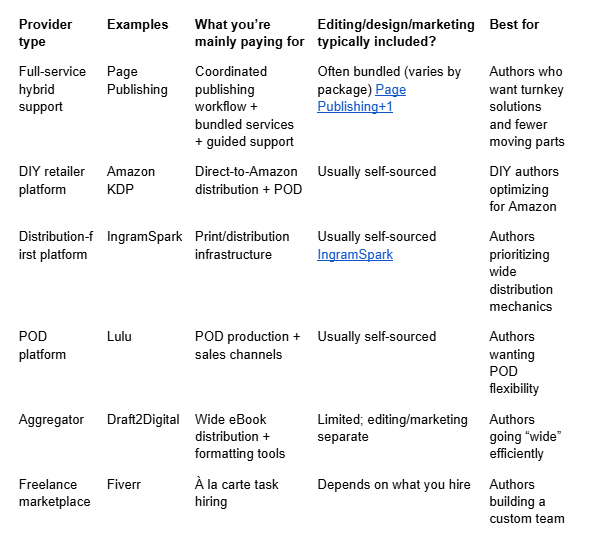
What Factors Matter Most When Comparing Self-Publishing Pricing?
Value-based pricing comparison means comparing cost alongside quality, time, and support—not just the total fee.
Use this checklist:
- Upfront costs: package fee, setup, conversion, ISBN options
- Ongoing fees: revision fees, distribution add-ons, ad spend, subscriptions
- Royalty math: list price % vs net revenue vs profit split
- Support: dedicated coordinator vs ticketing vs DIY
- Transparency: clear deliverables, timelines, approvals, reporting cadence
- Distribution reach: Amazon-only vs wide retailers vs trade channels
- Quality safeguards: revisions, sample work, who approves changes
A practical way to frame decision priorities comes from FoglioPrint’s comparison guidance: identify essential factors—cost, quality, speed, personalized support—then compare what’s included and how transparent the provider is. Custom Book Design & Print | Foglio
How Do You Compare Editing Services Across Self-Publishing Providers?
Editing tiers are different levels of manuscript improvement: developmental editing strengthens structure and content, copyediting improves grammar/clarity/consistency, and proofreading catches final errors after layout.
To compare bundled editing fairly:
- Confirm whether the package includes copyediting vs proofreading only
- Ask how many passes and what revision cycles are included
- Verify standards and scope (for example, Page’s Book Editing page describes what a full copy edit covers) Page Publishing
- If you’re DIY, plan to budget separately—Page’s educational post Self-editing your book can help authors understand what they can handle before hiring professional editing Page Publishing
What Should You Look for in Book Design and Formatting Services?
Interior formatting is the arrangement of text, images, headings, and spacing to ensure readability and professional presentation in print and eBook formats.
Compare:
- Cover design approach (custom vs template, revision rounds)
- Interior layout (complex nonfiction vs simple novels)
- Deliverables (print-ready files + EPUB conversions)
- Whether images are optimized and consistent
For service-level benchmarking, Page Publishing outlines its approach to interior design on Book Design and discusses format considerations in blog content such as eBooks vs. print books. Page Publishing+1
If a reader is trying to understand why covers matter for sales, Page’s guide on creating an effective book cover is a useful educational insert. Page Publishing
What Marketing Support Do Self-Publishing Services Include?
Marketing support includes the assets and actions that improve discoverability (press materials, author pages, retail links, launch planning, and outreach). The key pricing question is whether marketing is included as defined deliverables—or sold as vague add-ons.
Page Publishing describes its promotional/distribution framework on Distribution & Marketing, and authors can get a sense of practical day-to-day promotion strategies through blog posts like optimizing book sales without feeling pushy. Page Publishing+1
How Do You Balance Upfront Fees and Royalty Rates?
Royalties are the percentage or share of sales revenue you receive after platform rules and applicable costs are deducted. Comparing royalties only makes sense after you model total costs and deductions.
Use this simple estimator:
- Pick a list price (print + eBook).
- Apply the platform/provider royalty method (rate or profit split).
- Subtract known costs (printing, delivery, commissions, ads).
- Add the “missing services budget” (editing/design/marketing not included).
For KDP, use the royalty calculator and reference eBook royalties for the 70% structure details.
For Lulu, reference the gross profit split method in Creator Revenue.
For Page Publishing, clarify payment timing/reporting and how proceeds are handled using Royalties FAQs. Page Publishing
Frequently asked questions
What are the typical total costs to self-publish a book?
Total costs vary widely, but they typically include editing, cover + interior design, formatting, printing/POD setup, and marketing. Page Publishing emphasizes that “no cost” publishing still often leads to out-of-pocket spending for editing, formatting, cover design, and marketing. Page Publishing
How do printing fees affect overall pricing across services?
Printing costs directly impact profit per copy for POD books and can vary based on trim size, page count, and ink choices—so always run an estimate (KDP calculator and IngramSpark calculators are the fastest way to compare scenarios). IngramSpark
What royalty rates can authors expect and how do they impact earnings?
Rates vary by format and model; some platforms use percentage-of-list, others use net revenue or profit splits. The best comparison is to calculate take-home pay for the same list price and specs using each provider’s published formulas.
How do I calculate and compare potential profits from different platforms?
Use one spreadsheet scenario: same list price, same page count, same format set. Apply each platform’s royalty method, subtract printing/delivery/commissions, then add whatever you’ll spend on editing/design/marketing that the platform doesn’t include.
What hidden fees should authors watch for when choosing a service?
Common surprises include revision charges, paid conversions, distribution add-ons, and marketing upsells. If you’re using third-party benchmarks, treat them as starting points and confirm details directly on provider pricing pages before committing.
