
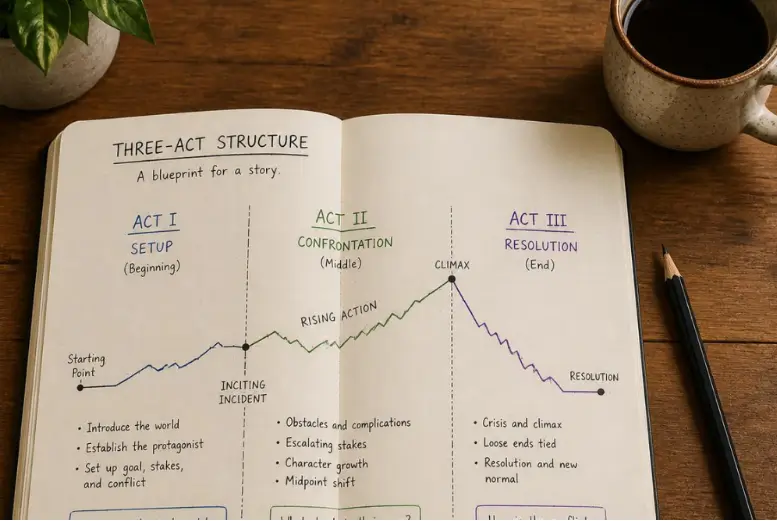
If you’re a writer staring down a messy draft or a blank page, few things offer more clarity than the classic 3-act structure. It’s been used across centuries, genres, and mediums – from Greek tragedies to Marvel movies – because it works. Not just for plot, but for pacing, character arcs, and emotional impact.
The best part? You don’t need to be a screenwriter or outlining expert to use it.
Let’s break it down.
What Is the 3-Act Structure?
At its core, the 3-act structure divides a story into three parts:
- Beginning (Setup)
- Middle (Confrontation)
- End (Resolution)
Each act has its own role to play – and when you understand how they flow together, you can build stories that feel complete, intentional, and emotionally satisfying.
Act 1: The Setup (Approx. 25%)
What it does:
- Introduces your protagonist and their world
- Establishes what’s missing, off, or in conflict
- Ends with a decision or event that changes everything
Key beats to hit:
- Hook: Draw the reader in with curiosity or tension
- Inciting Incident: A disruption that sparks the plot
- First Plot Point: A decision or event that launches the story
Think of it as:
The “normal world” – right before everything changes.
Questions to ask yourself:
- Who is your protagonist, and what do they want?
- What’s at stake if nothing changes?
- What event forces them to act?
Act 2: The Confrontation (Approx. 50%)
What it does:
- Raises the stakes and deepens the conflict
- Shows your protagonist reacting, learning, and evolving
- Builds toward a major turning point
Key beats to hit:
- Rising Action: A series of challenges, twists, or complications
- Midpoint: A major revelation, shift in power, or emotional pivot
- Second Plot Point: A “dark night” or moment of crisis that changes everything
Think of it as:
The heart of your story – where things get messy, risky, and real.
Questions to ask yourself:
- What does your protagonist think they need – and what do they actually need?
- What forces are pushing them to grow (or fall apart)?
- What’s the worst thing that could happen here?
Act 3: The Resolution (Approx. 25%)
What it does:
- Delivers the climax – where the central tension peaks
- Shows the result of your character’s choices
- Resolves major questions and emotional arcs
Key beats to hit:
- Climax: The final confrontation or decision
- Falling Action: The aftermath or consequences
- Denouement: A new “normal” – changed by the story’s events
Think of it as:
The payoff – where transformation becomes visible.
Questions to ask yourself:
- How has the protagonist changed (or not)?
- What does their final decision say about them?
- What do you want your reader to feel or reflect on?
Why the 3-Act Structure Works (Even If You Don’t “Like” Structure)
Some writers resist structure because it feels formulaic. But the 3-act framework isn’t about forcing your story into a box. It’s about clarity so that your story builds instead of wandering, escalates instead of stalling, and resolves in a way that feels earned.
It’s a tool not a rule.
Whether you’re a planner or a discovery writer, the 3-act structure can help you spot gaps, heighten drama, and pace your story with intention.
Final Thought: Use the Structure, Then Make It Yours
Great stories don’t come from structure alone. They come from heart, risk, truth, and persistence. But a solid structure can give those things a place to land and grow.
So if you’re feeling lost in your draft, try mapping it to the 3-act structure. You might be closer to a strong story than you think.
Because when you know where you are in the arc, you’re never truly stuck, just between acts.
