If you’re researching publishing options, you’ve probably seen “vanity press” used as a warning label (and sometimes as a catch-all insult for anything that isn’t traditional publishing). The problem is that misinformation makes it harder to choose confidently.
This guide breaks down the common myths about vanity publishing, clarifies the difference between self-publishing and
vanity publishing, and helps you avoid publishing industry scams so you can move forward with clearer expectations and fewer expensive surprises.
Understanding Vanity Publishing
Vanity publishing generally refers to publishing arrangements where an author pays a company (often significant fees) to produce a book, while the company’s primary profit comes from author payments, not reader sales. That incentive mismatch is why vanity presses are often associated with aggressive upselling, vague promises, and under-delivered services.
If you’re still sorting out what counts as traditional, self, hybrid, or vanity, this overview can help you quickly map the landscape: Types of Publishing Paths.
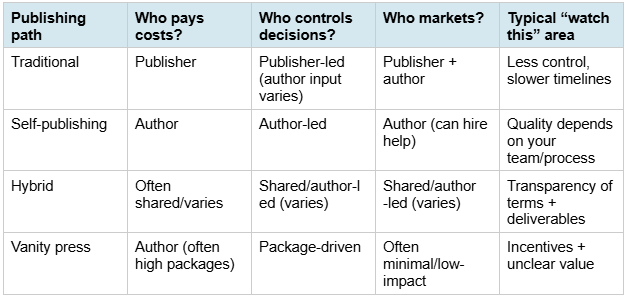
Traditional vs self vs hybrid vs vanity: core differences
If you want a deeper “how publishing works” foundation before myth-busting, The Publishers Guide is a useful big-picture reference.
Myth 1: Self-Publishing and Vanity Publishing Are the Same
One of the most common myths about vanity publishing is that it’s simply another name for self-publishing. In reality, the difference between self-publishing and vanity publishing comes down to control, transparency, and incentives.
Self-publishing is author-led: you decide who you hire, what you spend, and how your book is produced and marketed. Vanity publishing, by contrast, is typically package-based: the company’s main revenue often comes from charging authors high fees, sometimes while offering limited value in editing, marketing, or distribution support. In the worst cases, those tactics can be predatory.
Here’s a quick way to separate them:
- Self-publishing: You control production, choose your service providers, and (in many models) keep higher royalties because you’re funding the project and owning the process.
- Vanity publishing: You pay to be published, editorial oversight may be minimal, and the company’s profit may rely heavily on selling services and copies to you rather than selling books to readers.
Snippet-friendly quote: “Vanity publishing is not self-publishing with some help. The two models differ in who controls decisions, where revenue comes from, and how much value the author actually receives.”
If you want a clearer side-by-side explanation of where traditional, self, hybrid, and vanity models differ, Types of Publishing Paths is a helpful reference point. For a practical safety check before signing anything, 11 Essential Questions to Ask Before Choosing a Vanity Publishing Service walks through the exact transparency and contract details worth confirming.
Myth 2: All Published Books Guarantee Quality
It’s easy to assume that a book’s route to publication automatically signals quality, but how a book is produced matters far more than where it’s published. Even major traditional publishers release a mix of standout titles and disappointing ones, which challenges the idea that prestige alone guarantees excellence. As one myth-debunking analysis puts it: “Big Five publishers release both literary gems and poor quality books, challenging prestige myths.”
The more useful mindset is this: high-quality books can come from any publishing method (traditional, self-publishing, or hybrid) when the production process is handled professionally and the author stays engaged.
Independent success factors that actually drive quality (and results)
- Thorough editing (developmental editing, copyediting, proofreading, not just a quick pass)
- Professional design (cover design and interior formatting that matches genre expectations)
- Strategic marketing and platform building (clear audience, positioning, and consistent promotion)
- Reader engagement (reviews, email list, events, community building, and long-term visibility)
If you’re learning what “professional process” looks like beyond the myths, The Publishers Guide offers a helpful overview, and Exploring Print on Demand (POD) for Authors clarifies how modern production and availability can work in practice.
Myth 3: You Must Choose Either Traditional or Self-Publishing
Modern publishing isn’t an all-or-nothing decision. Many authors blend approaches over the course of their careers based on goals like speed, control, budget, distribution needs, and the level of professional support they want. As one myth-debunking source puts it: “You can choose multiple publishing paths; it’s not exclusive to one method.” [2]
Quotable definition (snippet-friendly): Hybrid publishing allows authors to combine elements of traditional and self-publishing, retaining more creative control while accessing professional services and broader distribution support.
If you’re weighing what each option typically includes (and what you still manage yourself), Types of Publishing Paths breaks it down clearly, and The Publishers Guide adds helpful context on how the overall process works.
Real-world scenarios authors commonly use
- Mixing models across books: You might self-publish one title (for speed, niche focus, or full control) and traditionally publish another (for broader retail reach or a different market strategy).
- Using hybrid support for specialty projects: A more complex book (like a heavily illustrated title, a premium print project, or a book that needs extra professional polish) may benefit from structured, transparent support like what’s outlined in Our Services.
The most important takeaway: the “right” path can change from one book to the next, and choosing a flexible strategy is often a smart, modern approach, not a sign you’re doing it “wrong.”
Myth 4: Vanity Publishers Provide Extensive Marketing Support
Marketing is one of the easiest promises to oversell and one of the hardest things to verify in a contract. The reality is simple: vanity publishers typically make their money from author fees, not book sales, so they’re rarely incentivized to market effectively. [1] If a company gets paid upfront whether your book sells or not, “marketing support” can become a vague line item instead of real promotion.
Featured-snippet definition: Marketing support in publishing includes promotional campaigns, publicity outreach, event coordination, and platform building designed to generate book sales.
A helpful starting point (no matter which path you choose) is building a clear marketing foundation: Book Marketing Ideas for Authors.
Legitimate marketing support vs. typical vanity “marketing”
[NOTE: Comparison table referenced in original draft was missing. Add table here comparing legitimate marketing deliverables vs. common vanity-style offerings.]
Step-by-step: how to evaluate marketing claims before you pay
- Ask for deliverables in writing. “Marketing” should list actions (what), quantity (how many), timing (when), and ownership (what you keep).
- Look for reporting language. If ads or outreach are included, there should be a commitment to performance reporting (even basic metrics).
- Separate “distribution” from “marketing.” Retail availability isn’t the same as promotion; marketing is what drives discovery.
- Watch for vague guarantees. “Guaranteed exposure,” “Hollywood marketing,” or “bestseller” language is often a signal you’re buying hype, not measurable work.
- Confirm what you’ll still be responsible for. Most authors still do audience-building; the question is whether the company adds real, trackable support.
A practical contract-safety checklist for this exact issue: 11 Essential Questions to Ask Before Choosing a Vanity Publishing Service.
What real marketing support can look like (and what you can do yourself)
Even if you’re self-publishing, many platforms give you access to marketing tools (sales dashboards, metadata controls, pricing promos, ad platforms, and audience targeting). The key is using those tools strategically and consistently.
If you’re building your plan, these author resources are strong “next steps”:
- Leveraging Social Media: A Guide for Authors
- 12 Social Media Post Ideas for Authors
- Top Tips: 4 Easy Steps for Video Book Marketing
- Maximizing Local Media Coverage: Tips for New Authors
Myth 5: Publishing Automatically Leads to Success
Publishing a book is a major accomplishment, but it doesn’t automatically guarantee sales, reviews, or recognition. That expectation is one of the most damaging publishing myths because it can cause authors to stop at “launch day” instead of building long-term visibility. As one industry commentary warns: “Most authors fail to sell books because they believe myths about publishing rather than building platforms.”
The reality is that successful publishing usually comes from ongoing effort, smart strategy, and consistent reader engagement, regardless of whether you publish traditionally, independently, or through a hybrid model.
What actually drives book success
- Consistent personal marketing: appearances, signings, podcasts, newsletters, and an active online presence that keeps your book discoverable beyond launch week.
- Leveraging social media marketing: social platforms remain essential for modern book discovery and reader connection, especially when used with a clear content rhythm and audience focus.
- Reviews + trust signals: reviews help readers feel confident taking a chance on a new author and improve visibility on many retail platforms.
- Direct communication with readers: an email list, reader community, or consistent engagement gives you a reliable way to reach your audience when algorithms change.
For practical, author-friendly guidance you can implement immediately, these resources are strong next steps:
- Book Marketing Ideas for Authors
- Leveraging Social Media: A Guide for Authors
- 12 Social Media Post Ideas for Authors
- Maximizing Local Media Coverage: Tips for New Authors
The takeaway: publishing opens the door, but consistent visibility and reader relationships are what turn a published book into a successful one.
Why These Myths Persist
Predatory publishing practices are misleading, high-pressure tactics that exploit authors through vague promises, overpriced services, and unfair contracts, earning money from authors rather than from selling books to readers.
These vanity publishing myths don’t survive because authors are careless. They persist because the publishing landscape is confusing, emotionally charged, and full of persuasive sales messaging. When you’ve worked for years on a manuscript, it’s normal to want validation, clarity, and a smooth path to publication. Unfortunately, that combination can make common publishing misconceptions feel believable, especially when they’re repeated by confident “publishing consultants” who are really salespeople.
1) Misinformation is profitable
Vanity-press-style businesses often rely on persistent, misleading sales tactics to attract first-time or inexperienced authors, promising “exposure,” “media attention,” or “bookstore placement” without clearly defining deliverables or results. These pitches can sound legitimate because they use real publishing terms, but the details are often vague, inflated, or structured to justify ongoing upsells.
A practical way to pressure-test promises against reality is 11 Essential Questions to Ask Before Choosing a Vanity Publishing Service.
2) The publishing model landscape isn’t widely understood
Many new authors only hear about two paths (traditional publishing or self-publishing), so anything in between can be confusing. Hybrid publishing, author services, distribution support, and vanity presses can blur together online, which makes it easier for misleading offers to hide in plain sight. A clear overview of the main models helps reduce that confusion: Types of Publishing Paths.
3) Emotional pressure makes myths feel true
Publishing taps into identity (“I’m an author”), hope (“my book deserves readers”), and urgency (“I don’t want to lose momentum”). Sales tactics often lean on those feelings with limited-time offers, exclusivity language, and repeated follow-ups, because urgency discourages careful comparison shopping.
How to Avoid Vanity Publishing Pitfalls
Avoiding vanity publishing problems comes down to two habits: spotting red flags early and verifying everything in writing. The goal isn’t to become suspicious of every paid service; it’s to make sure you’re paying for clear, measurable value with fair terms.
A solid starting point is this author checklist: 11 Essential Questions to Ask Before Choosing a Vanity Publishing Service.
Use this quick checklist to identify common vanity-press patterns:
- Requests for large upfront fees (often $5,000 to $25,000+) before you’ve seen detailed deliverables
- Lack of transparency in service delivery (unclear editing scope, vague design process, no timeline)
- Promises of marketing without specifics: “exposure,” “publicity,” “bookstore placement,” or “bestseller” language without measurable actions or reporting
- Overly aggressive sales pitches (frequent calls, urgency pressure, “today only” offers, emotional manipulation)
- Upsell ladders that keep expanding after you pay (new “required” services appear later)
If you want to compare what transparent support typically looks like across models, Types of Publishing Paths is a helpful reference.
Step-by-step due diligence (before signing or paying)
Research reputation and reviews
- Search the company name + “reviews,” “complaints,” and “scam”
- Look for patterns (especially upselling, non-delivery, rights issues, and refund disputes)
Ask for a clear contract and deliverables
- Get line-item deliverables (what you receive, how many, by when)
- Confirm what you own (files, ISBN usage, cover rights, formatted interiors)
- Make sure marketing claims include specifics and reporting
Request proof of results and real samples
- Ask for sample titles they’ve produced and check them for quality (cover, formatting, metadata, reviews)
- Request testimonials you can verify (not just quotes on a sales page)
Separate distribution from marketing
- Being “available” online isn’t the same as promotion
- Marketing should include defined actions (campaign planning, outreach, ads, events, platform strategy)
For more author-facing guidance on building real promotion (regardless of publishing path), start here:
Helpful related guides (internal links):
- Questions to ask your publisher: 11 Essential Questions to Ask Before Choosing a Vanity Publishing Service
- Hybrid publishing options: Types of Publishing Paths and Our Services
- Broader publishing education: The Publishers Guide
Making Informed Publishing Decisions
Choosing how to publish is ultimately about alignment: your goals, your budget, your timeline, and how hands-on you want to be. The most reliable way to avoid vanity pitfalls is to compare multiple options (traditional, self-publishing, hybrid, and other service-based approaches) and choose the one that matches your values with clear terms and measurable deliverables.
If you want a quick refresher on how the major models differ, Types of Publishing Paths is a helpful overview, and The Publishers Guide offers additional context on how the publishing process typically works.
Concise comparison: pros and cons by publishing path
Traditional Publishing Cost: Low upfront (publisher pays) Control: Lower (publisher-led) Quality/Support/Marketing: Varies by title and publisher priority
Pros: No production costs for the author, potential for broader retail distribution, industry validation
Cons: Less creative control, slower timelines, competitive to access, marketing support often limited unless you’re a lead title
Self-Publishing Cost: Variable (you set the budget) Control: Highest (author-led) Quality/Support/Marketing: Depends on your team and process
Pros: Full creative and business control, faster timelines, scalable, higher royalty potential
Cons: You manage everything, quality depends on who you hire, all marketing responsibility falls on you
Hybrid Publishing (Reputable) Cost: Medium to high (shared or fee-based) Control: Medium to high Quality/Support/Marketing: Can be high with a transparent process and defined deliverables
Pros: Professional guidance with author control, clearer timelines, services bundled transparently
Cons: Contracts and deliverables need careful vetting, costs vary widely across providers
Vanity Press Cost: Often high packages Control: Often unclear or package-driven Quality/Support/Marketing: Inconsistent, often overstated or vague
Pros: “Done-for-you” pitch, fast emotional appeal
Cons: Incentives misaligned with book sales, vague promises, frequent upsells, risk of weak quality and unfavorable terms
Key takeaways to guide your choice
- Ask who profits if your book doesn’t sell. Incentives matter as much as services.
- Insist on clarity. Editing scope, design rounds, timelines, marketing deliverables, and reporting should be written and measurable.
- Match the model to the book. Some projects benefit from full control; others benefit from structured professional support.
How Page Publishing supports informed decisions
If you’re looking for a path that emphasizes transparency, comprehensive support, and author control, Page Publishing operates as a hybrid partner focused on clear expectations and guided execution, distinct from vanity models that rely on vague packages and pressure tactics. You can explore what that support can look like here: Our Services.
And if you’re still learning and comparing options, you can browse additional author resources in the Page Publishing Blog and the Self-Publishing category.
Frequently Asked Questions
Is vanity publishing the same as self-publishing?
No. Self-publishing gives you creative and financial control (you choose your editor, designer, and platforms), and you often keep higher royalties because you’re managing the process. Vanity publishers typically charge large upfront fees, bundle services with unclear value, and may offer little meaningful marketing support. For a clear breakdown of publishing models, see Types of Publishing Paths.
Does paying a publisher guarantee my book’s success?
No. Paying a publisher does not guarantee sales, reviews, or recognition. Successful publishing depends on quality, market fit, and active marketing over time, plus reader engagement and long-term discoverability. A helpful starting point for building a realistic plan is Book Marketing Ideas for Authors.
Do vanity publishers offer real editing and marketing?
Often, vanity publishers provide minimal editing and weak or vague marketing. For example, “marketing” that’s just a generic press release or unclear “exposure” claims without measurable deliverables. Legitimate editorial and promotional support should be defined clearly in writing (scope, timeline, reporting). Use this due-diligence checklist before signing: 11 Essential Questions to Ask Before Choosing a Vanity Publishing Service.
Can vanity publishing hurt my chances of future traditional deals?
It can. If a vanity publisher locks up rights, delivers poor quality, or leaves weak sales history, it may make future traditional opportunities harder, especially if contracts limit your ability to re-release or revise the book. Protecting your rights and making sure you can exit fairly matters. The safest approach is to verify contract terms and deliverables early using 11 Essential Questions.
Are all publishing companies that charge upfront fees vanity publishers?
No. Not every paid model is vanity publishing. Some hybrid publishers and professional service providers charge fees but operate transparently, with clear deliverables, fair terms, and measurable support. The key difference is whether the company is transparent and value-driven or relies on vague promises and aggressive upsells. A quick overview is here: Types of Publishing Paths, and you can browse additional guidance in the Page Publishing Blog.
References & Links
Internal links
External references
[1] nellharris.com. Beware Vanity Publishers: What Are They and Why Should You Avoid Them? https://nellharris.com/allthingsbookmaking/bewarevanitypublishers
[2] litreactor.com. Traditional, Indie, and Self-Publishing: 15 Myths Debunked https://litreactor.com/columns/traditional-indie-and-self-publishing-15-myths-debunked
[3] rising-authors.com. The Publishing Industry is Full of Myths https://www.rising-authors.com/resources/the-publishing-industry-is-full-of-myths