
How to Choose a Trustworthy Self-Publishing Service for Your First Book

woman in glasses sitting on the couch browsing on a tablet device

Understanding Your Publishing Needs

A self-publishing service is a company or platform that helps authors produce, distribute, and market their books without going through a traditional publishing house. If you are publishing your first book, clarifying your goals is the essential first step toward selecting a trustworthy self-publishing service that aligns with your vision, budget, and expectations. Before comparing self-publishing companies, authors should assess what kind of support they truly need throughout the publishing journey.

Start by listing the services you may require, such as professional editing, cover design, interior formatting, ebook and print conversion, audiobook production, distribution, and marketing support. First-time authors often underestimate how many steps are involved in publishing a book, and overlooking these needs early can lead to unnecessary delays or added costs later.

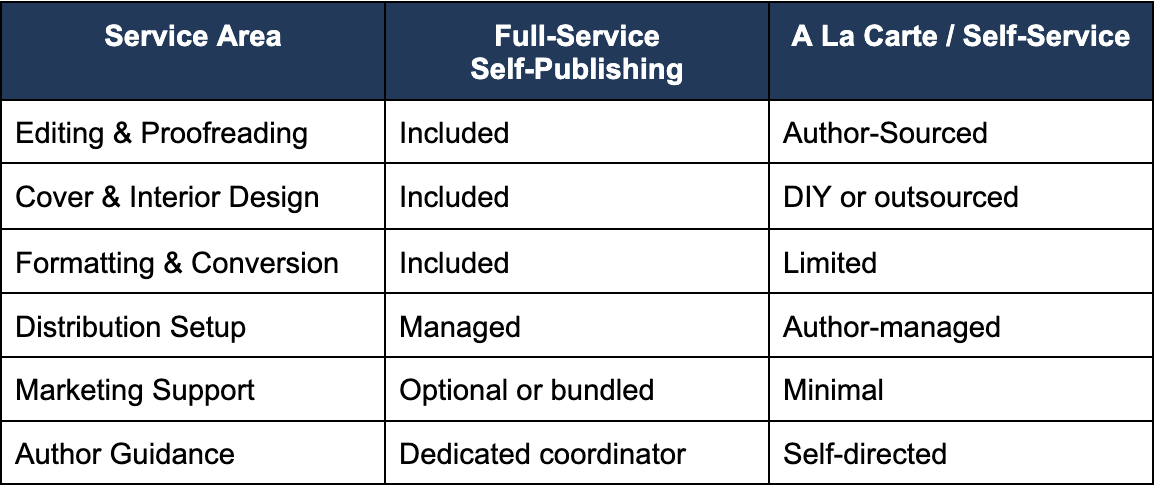
Full-service self-publishing is a publishing model in which a single company manages all aspects of book production, distribution, and promotion on the author’s behalf. This approach differs significantly from à la carte or self-service platforms, where authors coordinate individual vendors themselves.

Working with a full-service self-publishing partner like Page Publishing is especially appealing for first-time authors who want professional guidance without managing every step alone. Authors who prefer a managed approach often choose companies offering professional editing, design, and distribution services under one coordinated process rather than juggling multiple vendors.

A key differentiator of Page Publishing is its emphasis on hands-on support, including the assignment of a dedicated publication coordinator to guide authors through each phase of the publishing process.


self-publishing table of included services

Working with a full-service self-publishing partner like Page Publishing is especially appealing for first-time authors who want professional guidance without managing every step alone. Authors who prefer a managed approach often choose companies offering professional editing, design, and distribution services under one coordinated process rather than juggling multiple vendors.

A key differentiator of Page Publishing is its emphasis on hands-on support, including the assignment of a dedicated publication coordinator to guide authors through each phase of the publishing process.

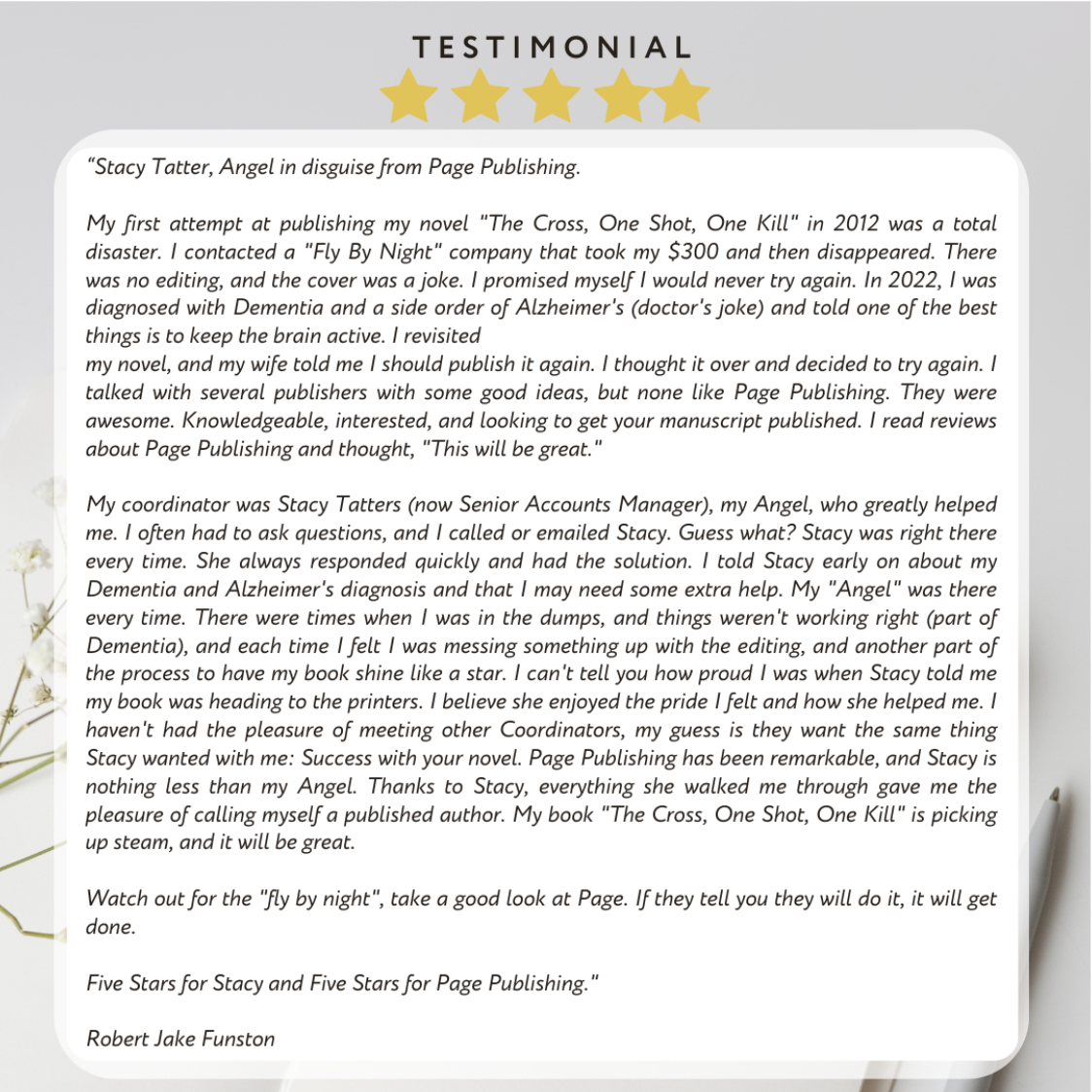
customer testimonial

Researching Self-Publishing Companies

A trustworthy self-publishing company is a provider with transparent pricing, verifiable author testimonials, and a track record of producing professional-quality books. Thorough evaluation of self-publishing companies helps authors avoid scams, low-quality services, and unexpected costs. When researching the best self-publishing services, prioritize transparency and author support over flashy promises.

Authors should research company backgrounds, leadership experience, and years in operation, as well as read testimonials and third-party reviews. Relying solely on a company’s website can be misleading, so cross-checking claims with external sources is essential for finding a trustworthy partner.

Creating a checklist can help streamline this research. Important factors to evaluate include:

  • Range of services offered
  • Responsiveness and accessibility of customer support
  • Years in business
  • Industry reputation

Author communities such as Kboards and Absolute Write are valuable spaces for networking and gaining unfiltered peer feedback about self-publishing companies.

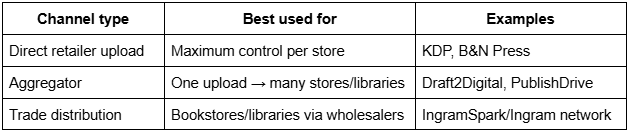
An aggregator is a service that distributes a book to multiple retailers or libraries on the author’s behalf, often simplifying wide distribution but offering limited hands-on support. Understanding this distinction helps authors evaluate whether they need a full-service partner or simply a distribution channel.

Evaluating Distribution and Reach

Book distribution is the process of making a book available for purchase through retailers, libraries, and online platforms. Distribution plays a major role in a book’s visibility and long-term sales potential, so authors should examine how widely their book will be available and whether the service can reach both domestic and international audiences.

Wide distribution is the practice of making a book available across multiple platforms and retailers rather than relying on a single storefront. Compare distribution networks carefully and confirm whether the service partners with major online retailers such as Amazon, Barnes & Noble, Apple Books, and Kobo, as well as library systems.

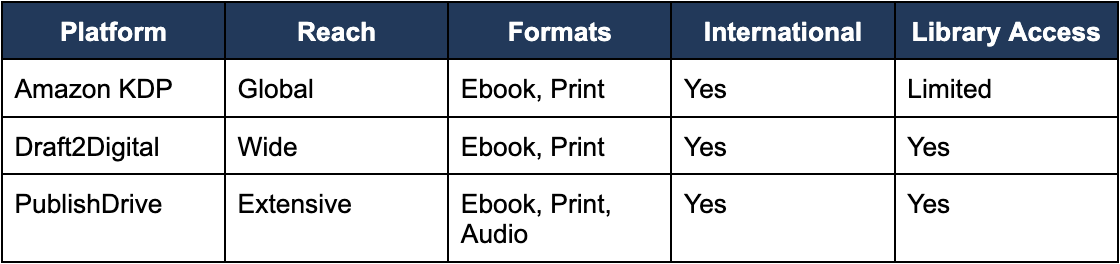
Some widely recognized distributors include Amazon KDP, PublishDrive, and Draft2Digital.

platform, format and access table for books

Understanding distribution reach helps authors choose a self-publishing service that maximizes discoverability while aligning with their marketing strategy.

Analyzing Pricing, Fees, and Royalties

A royalty is the percentage of book revenue paid to the author after each sale, typically ranging from 35% to 70% depending on platform, format, and pricing strategy. Understanding pricing structures and royalty models is essential for avoiding financial surprises. Self-publishing services generally use one or more of the following pricing approaches:

  • Upfront service fees
  • Royalty splits
  • Pay-per-service pricing
  • Hybrid models

Some full-service self-publishing providers offer publishing packages tailored to different author needs, allowing authors to understand costs upfront rather than navigating fragmented pricing.

Authors should also be cautious of platforms marketed as “free.” Understanding the true cost of “no-cost” publishing often reveals trade-offs in royalties, control, or support that may not be immediately obvious.

Clear royalty tracking tools and transparent payment schedules are important indicators of a trustworthy self-publishing service.

Reviewing Contracts and Rights Retention

Rights retention is the principle that authors maintain ownership and control of their intellectual property, including the copyright, ISBN, and decisions about where and how the book is published. Contracts determine who controls your book, making this step especially important for first-time authors publishing their first book. Always read agreements carefully and seek clarification on unclear language.

Key elements to review include:

  • Copyright ownership
  • ISBN assignment
  • Exclusivity requirements
  • Termination and exit clauses

Authors should be wary of contracts that include broad rights grabs, long-term exclusivity, or vague royalty calculations. Trustworthy self-publishing companies prioritize transparency and author ownership.

Red flags in self-publishing contracts:

  • Unclear or ambiguous copyright ownership language
  • Vague royalty calculations or undefined “net” amounts
  • Long-term exclusivity requirements (5+ years or perpetual)
  • Complicated exit clauses or termination fees
  • No clear process for rights reversion
  • Contracts that require ongoing payments to maintain availability

Assessing Quality Control and Author Support

Quality assurance in self-publishing refers to the professional standards, processes, and checkpoints that ensure a book meets industry expectations for editing, formatting, design, and production. Professional quality and reliable support are two pillars of a trustworthy self-publishing partner. High-quality books require professional editing, formatting, and design to meet reader expectations and compete effectively in the marketplace.

The Case for Professional Editing and Design

While authors can handle some tasks independently, outsourcing editing and design to professionals significantly improves the final product. Tools like Grammarly and ProWritingAid help authors polish their manuscripts before professional editing, catching basic errors and improving readability. For formatting and layout, software such as Vellum and Adobe InDesign produces publication-ready files that meet retailer specifications. These tools enhance quality at every stage, but they work best when paired with experienced human editors and designers who understand genre conventions and reader expectations.

For cover design, many authors and services use tools like Canva or Adobe Spark to create professional-looking covers, though custom designs from experienced cover designers typically outperform template-based options. For ebook conversions, Calibre remains a popular tool for formatting and file management, particularly for authors distributing across multiple platforms.

Evaluating Author Support

Equally important is access to real human support throughout the publishing process. Authors should verify that a self-publishing service offers personal guidance, timely communication, and resources for troubleshooting problems as they arise. Services that assign a dedicated publication coordinator—a hallmark of Page Publishing—offer clearer communication, accountability, and personalized guidance from manuscript submission through publication and beyond.

When evaluating support, ask:

  • Will I have a single point of contact or be passed between departments?
  • What is the typical response time for questions or concerns?
  • Are there resources available if I encounter problems with formatting, distribution, or marketing?

Quality Assurance Checkpoints

Trustworthy self-publishing services build quality assurance into their workflow. Key checkpoints include professional proofreading after layout, formatting verification to ensure files display correctly across devices, and pre-publication review to catch any remaining issues before the book goes live. These steps help ensure the final product meets professional standards and reflects well on both the author and the publisher.

Authors should ask prospective services what quality control steps are included and who is responsible for final approval before publication.

Comparing Notable Self-Publishing Platforms

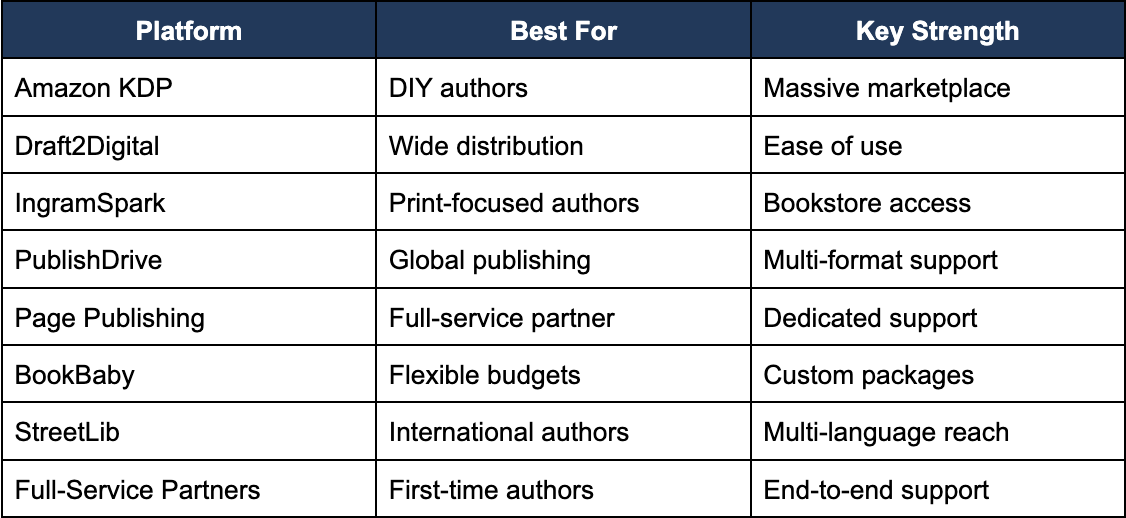
A self-publishing platform is a service or marketplace that enables authors to publish, distribute, and sell their books independently. Comparing leading platforms helps authors identify the best self-publishing services for their specific goals and determine which model fits their needs.

Print-on-demand is a publishing model where books are printed only when ordered, reducing inventory costs and financial risk. Many modern platforms rely on print-on-demand to balance flexibility with professional production quality.

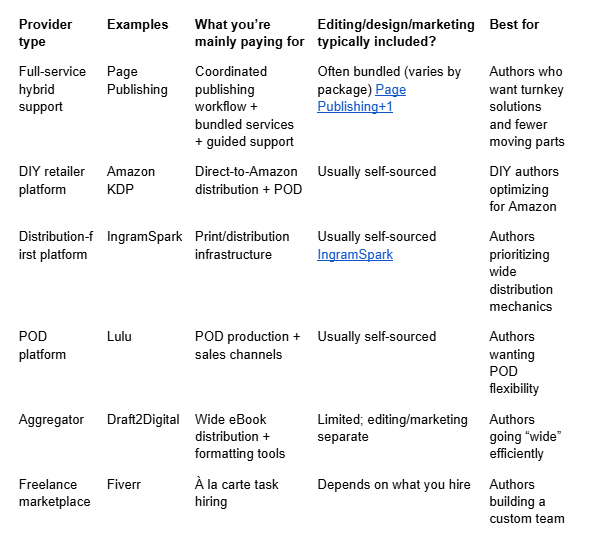
book platform and strength table

While DIY platforms offer control, full-service self-publishing providers appeal to authors seeking ongoing guidance and partnership, especially those publishing their first book.

Making the Final Decision: Finding the Best Fit

Choosing a trustworthy self-publishing service for your first book requires weighing all factors together. Authors should balance budget, desired level of involvement, and long-term goals when making a decision.

A simple self-assessment can help narrow options:

  • Do I want hands-on guidance or full independence?
  • Am I comfortable managing vendors myself?
  • How important is professional marketing and distribution support?

Reading author success stories and testimonials can provide reassurance and insight into real publishing experiences with different self-publishing companies.

Ultimately, patience, realistic expectations, and a commitment to quality and marketing are key drivers of long-term self-publishing success.

Frequently Asked Questions

How do I choose a trustworthy self-publishing service?

Evaluate self-publishing companies based on reputation, pricing transparency, contract terms, distribution quality, range of services, and author support. Research third-party reviews and author testimonials to verify claims made on company websites. The best self-publishing services provide clear information upfront and assign dedicated support to guide you through the process.

How can I ensure I retain full rights to my book?

Review contracts carefully to confirm you retain copyright ownership and control over distribution. Look for clear language about ISBN ownership, exclusivity terms, and your ability to terminate the agreement and move your book elsewhere. Trustworthy self-publishing companies make rights retention a priority.

What typical costs and royalties should I expect?

Costs vary widely based on services selected. Royalties typically range from 35% to 70%, depending on platform, format, and pricing strategy. Full-service self-publishing packages often include upfront fees but provide comprehensive support, while DIY platforms may have lower costs but require authors to source services independently.

How important is professional editing and design in self-publishing?

Professional editing and design are essential for producing a high-quality, competitive book. Readers judge books by their covers and quickly abandon poorly edited content. These investments directly impact reviews, sales, and your reputation as an author.

What are common warning signs of unreliable publishing services?

Hidden fees, vague contracts, poor communication, unrealistic marketing claims, and pressure tactics are red flags. Trustworthy self-publishing services provide clear pricing, transparent terms, and verifiable author testimonials.

What is the difference between full-service self-publishing and DIY platforms?

Full-service self-publishing provides comprehensive support, including editing, design, distribution, and a dedicated coordinator who guides you through each step. DIY platforms give authors tools to publish independently, but require managing each step alone, from hiring editors to uploading files to retailers. First-time authors often find full-service options less overwhelming.

How long does the self-publishing process typically take?

Timelines vary based on services selected and manuscript readiness. Full-service self-publishing typically takes 3-6 months from manuscript submission to publication, allowing time for editing, design, and production. DIY approaches depend entirely on the author’s pace and how quickly they can coordinate vendors and complete each step.

Should I use an aggregator or publish direct to retailers?

Aggregators simplify wide distribution by sending your book to multiple retailers through one upload, saving time and reducing complexity. Publishing direct to each retailer offers more control and sometimes higher royalties, but requires managing each platform separately. Many authors use a hybrid approach, publishing direct to Amazon while using aggregators for other retailers.

11 Essential Questions to Ask Before Choosing a Vanity Publishing Service

11 Essential Questions to Ask Before Choosing a Vanity Publishing Service

gray book on gray background with the title 11 questions to ask before choosing vanity publishing service

Choosing a publisher is one of the biggest decisions you’ll make as an author. You’ve poured your heart into writing your manuscript, and now you need a partner who will help bring your book to life in a way that honors your vision and protects your interests.

The problem? Many first-time authors don’t know what questions to ask until it’s too late. They sign contracts without fully understanding the terms, only to discover hidden fees, disappointing royalty structures, or services that fall far short of what was promised.

This isn’t about being suspicious or confrontational. It’s about doing your homework. Any reputable publisher will welcome these questions and answer them clearly and thoroughly. If a publisher gets defensive or evasive when you ask for details, that’s a red flag worth paying attention to.

Here are 11 essential questions every author should ask before signing on the dotted line.

Table of Contents

  1. Who Retains the Copyright to My Book?
  2. What Are the Total Upfront Costs, and What Exactly Am I Paying For?
  3. What Is Your Royalty Structure, and When Do I Start Earning 100% of Profits?
  4. What Level of Editing Is Included?
  5. Where Will My Book Be Distributed, and How Does That Process Work?
  6. Do You Reject Any Manuscripts, and If So, Why?
  7. What Marketing Support Is Included vs. What Costs Extra?
  8. How Long Is the Contract Term, and What Are My Rights After It Ends?
  9. What Formats Will My Book Be Available In?
  10. How Long Does the Publishing Process Typically Take?
  11. Will I Have a Dedicated Point of Contact Throughout the Process?
  12. Recognizing Common Pitfalls in Vanity Publishing Contracts
  13. Take Your Time and Make an Informed Decision

1. Who Retains the Copyright to My Book?

This should be your first question, and the answer should always be the same: you do.

Your copyright is your ownership of the work you created. A legitimate publisher should never ask you to transfer your copyright to them. You’re giving them permission to publish your book, not ownership of your intellectual property.

Red flag: Any publisher asking you to sign over your copyright should be avoided. Full stop.

What to look for: Clear contract language stating that you retain 100% copyright ownership.

With Page Publishing: You maintain full copyright ownership of your book, now and always, ensuring your continued control over how your work is used and presented.

2. What Are the Total Upfront Costs, and What Exactly Am I Paying For?

Publishing a book costs money. Whether those costs come from the publisher’s pocket (traditional publishing) or yours (self-publishing or hybrid publishing), someone is paying for editing, design, printing setup, and distribution.

The key is transparency. You deserve to know exactly what you’re paying for and what’s included.

Red flags: Vague pricing like “minimal investment” without specifics, or discovering surprise fees after you’ve already signed a contract.

With Page Publishing: We offer comprehensive publishing packages designed to suit a wide range of author needs. Whether you want essential publishing services or more extensive marketing and distribution support, you can choose a package that fits your goals and budget. You can review all package details, including what’s included at each level, on our website:

3. What Is Your Royalty Structure, and When Do I Start Earning 100% of Profits?

Royalty structures vary wildly across publishers. Some traditional publishers might give you 10-15% of net proceeds. Some self-publishing services take 40-60% of every sale forever. Others offer more author-friendly terms.

You need to understand not just the percentage, but how long those terms last and what happens to your earnings over time.

What to look for: A clear explanation of how royalties are calculated, what percentage the publisher takes, and whether those terms change over time.

Questions to ask: 

  • Do I earn back my investment before the publisher takes their share? 
  • What percentage does the publisher keep after I’ve recouped my costs? 
  • Are there different royalty rates for paperback, hardcover, and eBook formats?

With Page Publishing: You receive 100% of the profit generated from each sale until you have recouped your entire publishing investment. After you’ve reached that point, Page retains only 20 cents per book sold, allowing you to keep the vast majority of royalties over the long term.

4. What Level of Editing Is Included?

Not all editing is created equal. Understanding what type of editing you’re receiving helps you know what to expect and whether you might need additional editorial support before submission.

Different types of editing serve different purposes:

  • Developmental editing focuses on big-picture issues like plot, structure, and character development
  • Line editing improves flow, style, and readability at the sentence level
  • Copyediting fixes grammar, punctuation, spelling, and consistency
  • Proofreading catches final typos and formatting issues

What to look for: Clear explanation of which type(s) of editing are included in your package. 

Questions to ask: 

  • What type of editing do you provide? 
  • Is it developmental, line editing, copyediting, or proofreading? 
  • How many rounds of editing are included? 
  • Will I have an opportunity to review and approve changes? 

With Page Publishing: Your dedicated copy editor will give your manuscript a thorough polish, reviewing grammar, spelling, word choice, sentence flow, and consistency, while following the Chicago Manual of Style to ensure professional quality. You’ll have the opportunity to review every edit and approve or decline any changes before the manuscript moves forward.

5. Where Will My Book Be Distributed, and How Does That Process Work?

Getting your book printed is only half the battle. You need it to actually reach readers, which means distribution matters enormously.

Some publishers only upload to Amazon. Others work with major distributors like Ingram, which means your book can be ordered by bookstores and libraries nationwide.

What to look for: Specific distribution channels and retailers where your book will be available.

Questions to ask: 

  • Will my book be available through Ingram? 
  • Can bookstores order it? 
  • Will it appear on Amazon, Barnes & Noble, and other major retailers? 
  • What about international distribution?

With Page Publishing:Your printed book will be available through Ingram, one of the world’s leading book wholesalers. This gives bookstores and libraries the ability to order your title through their standard purchasing systems. Ingram also offers international reach, making your book available to retailers and libraries in markets such as the United Kingdom, Europe, Australia, and beyond.

Pro tip: While placement is always at a librarian’s discretion, many local libraries enjoy supporting community authors and will often consider adding locally written books to their collections.

6. Do You Reject Any Manuscripts, and If So, Why?

This might seem like an odd question, but it’s actually really important. Publishers who accept every single manuscript that comes through the door, regardless of quality, often provide little to no quality control or meaningful editorial guidance.

A publisher that maintains some standards and occasionally says “this isn’t ready yet” or “this isn’t a good fit for us” is usually a better partner than one that rubber-stamps everything.

What to look for: Evidence that the publisher has quality standards and won’t publish just anything.

Questions to ask: 

  • What percentage of submitted manuscripts do you accept? 
  • What are the common reasons you reject manuscripts? 
  • Do you provide feedback if you decline a manuscript?

With Page Publishing: We review every manuscript to ensure it’s a good fit for our program and meets basic publishing standards. We don’t require a fully edited or finalized document—that’s part of the service we provide—but we do look for a manuscript that is complete, clearly written, and thoughtfully organized. Our goal is to partner with authors who are ready to bring their work to the world professionally.

While we work with writers at many different experience levels, we do not accept manuscripts that include hate speech or content that violates our publishing guidelines.

In short: if your manuscript reflects genuine effort and a clear vision, we’re here to help you transform it into a finished book you can be proud of.

7. What Marketing Support Is Included vs. What Costs Extra?

Here’s where things can get tricky. Many publishers blur the line between what’s included in your package and what they’ll try to upsell you on later.

Basic distribution (making your book available for sale) is not the same as marketing (actively promoting your book to drive sales). You need to understand what comes standard and what requires additional investment.

What to look for: A clear breakdown of included services versus optional paid marketing packages.

Red flags: Publishers who make unrealistic promises about bestseller lists or guaranteed sales numbers. No one can promise your book will be a bestseller.

Questions to ask: 

  • What marketing services are included in my package? 
  • What marketing options are available for an additional fee? 

With Page Publishing: Every publishing package includes the essential steps needed to prepare and launch your book: copy editing, page and cover design, printing setup, eBook conversion, and distribution. Each package also includes a foundational marketing component, such as a professionally written press release, online listings, and guidance on promoting your book.

For authors who want more support, we offer optional marketing packages that expand your reach through additional services like advertising, targeted promotions, and enhanced media outreach. This allows you to choose the level of marketing that matches your goals and budget.

Audiobooks can also be added as an optional upgrade, giving your book a presence in multiple formats.

8. How Long Is the Contract Term, and What Are My Rights After It Ends?

Some publishing contracts last for a specific period (like 3-5 years), while others are perpetual or only end when the book goes out of print (which might never happen in the age of print-on-demand).

You need to understand what you’re committing to and what happens when the contract ends.

What to look for: Clear language about contract duration and rights reversion.

Questions to ask: 

  • How long does this contract last? 
  • Can I renew or end it at that point? 
  • What happens to my book files, ISBN, and cover design when the contract ends? 
  • Do my rights automatically revert to me?

With Page Publishing: Our contracts are intentionally short and author-friendly. We use a two-year contract term, and when that period ends, you can simply renew if you’d like to continue. Most importantly, you always retain full rights to your work. We don’t acquire your copyright, so there’s nothing to “revert” when the contract ends. Your book is yours at every stage.

When it comes to assets, the ISBN remains with Page Publishing, since it’s issued under our publishing imprint, but your book files are always accessible in your author portal. You can download them anytime, and if you ever need the production files (like the InDesign package), our team can provide them upon request.

https://en.wikipedia.org/wiki/ISBN

9. What Formats Will My Book Be Available In?

Understanding which formats your book will be published in helps you reach different types of readers. Some people prefer physical books, while others exclusively read eBooks or listen to audiobooks.

What to look for: Clear information about which formats are included in your package and which might be additional options.

Questions to ask: 

  • Will my book be available in paperback, hardcover, eBook, and audiobook formats? 
  • Are all formats included, or do some cost extra? 
  • How long does it take to produce each format?

With Page Publishing: Your book will be published in both a print format and an eBook format. Every author chooses whether they prefer a paperback or hardcover edition for their print version, and you may upgrade to offer both formats if you’d like wider availability. Your printed book will feature a glossy, full-color cover with professional binding. We also provide complimentary copies for events, signings, or personal use.

In addition to print, we convert your manuscript into ePub and AZW formats so it can appear on Apple Books, Amazon Kindle, Barnes & Noble Nook, and all major eBook platforms.

Audiobooks are available as an optional upgrade for authors who want to expand into other formats.

10. How Long Does the Publishing Process Typically Take?

Knowing the timeline helps you plan book launches, marketing efforts, and manage your expectations throughout the process.

What to look for: A realistic timeline from manuscript submission to books being available for sale.

Questions to ask: 

  • What are the major milestones in the publishing process? 
  • How long does editing typically take? 
  • When will I see cover designs? 
  • How long from final approval to books being available on retailer websites?

With Page Publishing: Most books progress from manuscript to retail availability in 6–8 months, and we aim to keep all projects within a 10-month timeline. Actual timing depends on factors such as revision cycles, author response times, and project details. Our publishing process moves through clear milestones, including editing, interior layout, cover design, author review, and final production, so authors always know where they are in the publishing journey.

11. Will I Have a Dedicated Point of Contact Throughout the Process?

Publishing a book involves many moving parts: editing, design, production, distribution, and marketing. Authors often feel lost when they’re passed from department to department with no one person truly responsible for their project.

Some vanity publishers rely on generic email inboxes or rotating support teams, which can leave authors repeating themselves or struggling to get consistent answers. A lack of personalized guidance is one of the most common pain points authors report.

What to look for: A clear explanation of who your main point of contact will be, how communication works, and whether you’ll have someone to guide you through the entire process.

Questions to ask: 

  • Will I be assigned a dedicated coordinator or project manager? 
  • How often will I hear from them? 
  • Can I speak to someone by phone if needed? 
  • Will I have access to my project’s status and files?

With Page Publishing: Every author is assigned a dedicated Publication Coordinator who guides you through each stage of the publishing process. You’ll always know who to contact, and you’ll have a consistent, knowledgeable partner who understands your book and your goals. Plus, you’ll have full access to your project files and workflow through your personalized Author Portal, so you’re never left wondering where things stand.

Recognizing Common Pitfalls in Vanity Publishing Contracts

Understanding typical traps – financial and legal – prepares you to avoid permanently damaging your publishing journey.

Excessive fees are the most obvious pitfall. Vanity publishers often charge $10,000 to $40,000 for services that self-published authors can obtain for $3,000 to $7,000 by hiring freelancers directly. The markup funds the publisher’s profit, not superior quality.

Rights grabs occur when publishers demand broad, long-term rights without corresponding investment or effort. Life-of-copyright clauses – where the publisher controls your work for your entire life plus 70 years – are particularly dangerous in vanity contracts. Unlike traditional publishers who actively promote backlist titles, vanity presses often abandon books after initial publication, leaving your rights tied up indefinitely with no benefit.

Delayed or withheld royalties result from net-profit calculations and high recoupment thresholds. Many authors never receive royalty payments because the publisher claims costs haven’t been recovered, even after years.

Forced purchases of unsold books financially exploit authors. Some contracts require authors to buy minimum quantities of their own books at inflated prices, sometimes as a condition of contract termination. According to industry watchdogs, authors have been pressured to purchase thousands of dollars of their own inventory to end unproductive relationships.

Inadequate marketing support is nearly universal in vanity publishing. Despite promises of “comprehensive promotion,” most vanity publishers provide only token efforts – a website listing, a press release sent to a generic database – leaving authors to handle all meaningful marketing themselves.

Option clauses and non-compete provisions tie up future works. Some vanity contracts include “right of first refusal” clauses requiring you to offer your next book to the same publisher, or non-compete clauses preventing you from publishing similar work elsewhere.

Take Your Time and Make an Informed Decision

Asking these questions isn’t about being difficult or distrustful. It’s about being a smart businessperson. Publishing a book is an investment of your time, money, and creative energy. You deserve to make that investment with full information.

Different publishers offer different services and business models. Traditional publishers, hybrid publishers, and self-publishing services each have their own approaches. The key is finding the right fit for your book, your budget, and your goals.

Take notes on the answers you receive. Compare your options side by side. And remember: you’re not just choosing someone to print your book. You’re choosing a partner for your publishing journey. Choose the option that feels right for you.

Your book deserves it. And so do you.

Have questions about how Page Publishing answers these questions? We believe in complete transparency throughout the publishing process. Visit our FAQ page to learn more about our services, royalty structure, contract terms, and what you can expect when you publish with us. We’re here to answer your questions honestly and help you make the best decision for your book.